
Where we work
We are drainage engineers and civil engineering designers working across Berkshire. We have delivered 15 projects here: drainage strategies, SuDS reports, flood risk assessments and highway design, prepared for planning and taken through to approval.
You do not need a consultant down the road from your site. This is desk work built on survey data, ground testing and the local authority’s own standards. What matters is that whoever does it knows what Reading, Wokingham, West Berkshire, Windsor and Maidenhead, and Slough asks for, and what the ground in Berkshire will actually do.
Our projects in Berkshire, in red, against the rest of England. One dot per project, placed within its postcode area rather than at the exact site. Zoom out for the full picture, or ctrl and scroll to zoom.
Civil engineering design in Berkshire
- Drainage design in Berkshire: surface water and foul drainage strategies, attenuation, SuDS and outfall design, sized for your site and your discharge rate.
- Flood risk assessments: site-specific flood risk assessments for sites in Flood Zones 2 and 3, and for sites over a hectare in Zone 1.
- SuDS design: sustainable drainage design and the SuDS statement your planning authority expects, with the drainage hierarchy worked through in order.
- Highway design: access, visibility splays, turning heads and adoptable road design, including Section 38 and Section 278 agreements.
- Percolation testing: BRE 365 soakaway testing across Berkshire, arranged through PT (West Midlands) Ltd so the design and the testing come from one place.
Ground conditions in Berkshire
Berkshire runs from Chalk across the west and centre, Ashbury and Hungerford through to Henley and Maidenhead, onto London Clay and Thames river terrace gravels in the east, with Bagshot Sands on the higher ground. Chalk and gravels can infiltrate; London Clay will not. On the floodplain the water table moves through the year, so a soakaway that drains in August can sit under water in February.
None of that tells us what is under your plot, and no report should pretend otherwise. It tells us what to expect, what to test for, and whether to plan for infiltration or for attenuation and a restricted discharge. A percolation test to BRE 365 settles it, and it is cheaper to do that before the design than to redesign afterwards.
Source: BGS Earthwise, London and the Thames Valley. Requirements and ground conditions both change: we check them at the start of every job.
The drainage hierarchy
- 1InfiltrationSoakaway or infiltration basin, if the ground takes it
- 2WatercourseDischarge to a surface water body, usually rate-restricted
- 3Surface water sewerWhere a public surface water sewer exists and has capacity
- 4Combined sewerLast resort, and increasingly refused outright
Every scheme has to work down this list in order, and show why each option above the chosen one was ruled out. The ground is what decides whether you get to stop at step one.
Berkshire at a glance
- Lead local flood authority
- Reading, Wokingham, West Berkshire, Windsor and Maidenhead, and Slough
- Postcode areas
- RG, SL
- Projects delivered here
- 15
- Statutory consultee
- Yes, on surface water for major development
- Percolation testing
- BRE 365, via PT (West Midlands) Ltd
- Case studies
- 5
What your Berkshire unitary authority expects
West Berkshire will not permit discharge to a foul sewer, a combined sewer or an existing highway drain through a planning application. If infiltration is not viable on a site there, the outfall has to be a watercourse or a dedicated surface water sewer, which is a constraint worth establishing before a layout is drawn.
Berkshire has no county council, so all six authorities are unitary and each sets its own standards. West Berkshire has translated the national non-statutory technical standards into local ones adjusted for climate change and urban creep; Wokingham publishes its own SuDS strategy with a technical guide.
Source: your Berkshire unitary authority. Requirements and ground conditions both change: we check them at the start of every job.
Flood risk assessments in Berkshire
Drainage is the bulk of what we do, but in Berkshire a large share of it comes with flood risk assessment attached, because the Thames and the Kennet dominate it, and floodplain sites are the norm rather than the exception.
A site-specific flood risk assessment applies the sequential and exception tests, works out the flood levels your site will actually see over its lifetime including an allowance for climate change, and sets finished floor levels, safe access and egress against them. your Berkshire unitary authority and the Environment Agency both look at it, and the commonest reason one comes back is that it assessed fluvial risk and ignored surface water.
We do this as part of the same job, so the flood risk assessment and the drainage strategy agree with each other rather than being written by two firms who never spoke. More on flood risk assessment.

What you need, and when
The work is not one document handed in once. It arrives in stages, and sending the wrong level of detail at the wrong stage is one of the commonest reasons an application stalls with your Berkshire unitary authority.
- Outline application. A strategy showing the principle: where the water goes, roughly what it will take, and that the site can be drained at all. Detailed calculations are not expected yet, but a strategy that ignores the discharge hierarchy will be questioned.
- Full application. The full surface water and foul scheme with calculations, layout, attenuation volumes and the discharge rate you are asking for, evidenced.
- Reserved matters. The detail that was reserved at outline, now built out against the approved strategy, and it has to match it.
- Discharge of conditions. The final submission against the wording of the condition itself, with the maintenance and management arrangements your Berkshire unitary authority asks for. This is the stage most people reach us at, often with a condition already imposed.
Where the work lands
- OutlineDrainage strategy: the principle, not the detail
- FullFull scheme, with calculations and discharge rate
- Reserved mattersThe detail, matching the approved strategy
- DischargeSubmission against the condition wording itself
Most people reach us at the last step, with a condition already imposed. That is fine: it is just cheaper to have got the strategy right at the first.
Typical conditions we discharge in Berkshire
Exact wording varies between officers and between applications, but conditions on sites here almost always fall into three shapes:
- Surface water drainage. “No development shall commence until a detailed surface water drainage scheme, based on sustainable drainage principles and an assessment of the hydrological and hydrogeological context of the development, has been submitted to and approved in writing by the Local Planning Authority.” This is the one that needs the percolation results and the attenuation calculations.
- Foul drainage. A scheme for foul water disposal, agreed before occupation, straightforward on a mains connection, considerably less so on a package treatment plant or where the sewer is at capacity.
- Management and maintenance. A plan setting out who maintains the drainage for the lifetime of the development, and how. Often overlooked, and a common reason a discharge application comes back.
If you have a condition in front of you, send us the wording. We will tell you what it actually requires, before you commit to anything. There is a fuller guide to drainage planning conditions if you want to read up first.
Our work in Berkshire
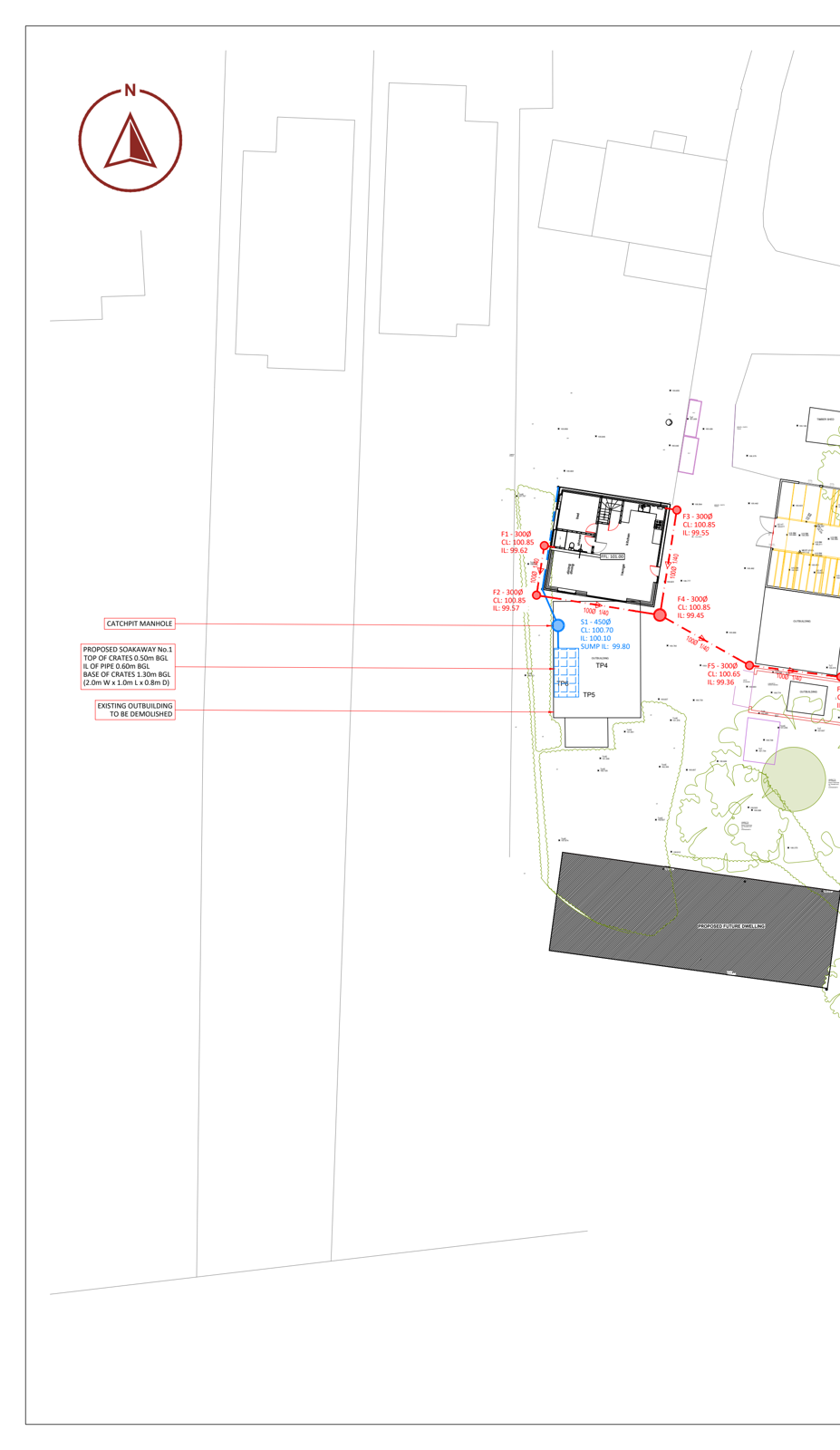
Past project locations here include Sunningdale, Maidenhead, Tilehurst, Frieth, Ravensworth Road and Reading.
- 2 dwellings in St Margrets
- A single dwelling in Gallowstree Common
- 4 dwellings in Berkshire
- An extension in Finchampstead, Berkshire
- A single dwelling in Berkshire
Questions we get asked in Berkshire
Do you need to be local to do this work?
No. It is done from survey data, ground investigation and your Berkshire unitary authority’s own standards, none of which require us to be nearby. Being the right distance from your site has never discharged a condition; knowing what the authority wants has.
Who is the lead local flood authority for my site?
Reading, Wokingham, West Berkshire, Windsor and Maidenhead, and Slough. They are a statutory consultee on surface water drainage for major development, and they set the local standards and the discharge rate your scheme is judged against.
Do I definitely need a flood risk assessment?
If your site is in Flood Zone 2 or 3, or is over a hectare in Zone 1, yes. Smaller sites in Zone 1 can still need one where there is a record of surface water flooding, and in Berkshire there often is. Send us the address and we will check the maps before you pay for anything.
Can a flood risk assessment get a refusal overturned?
Sometimes. An FRA that applies the sequential and exception tests properly, and shows safe access, egress and finished floor levels, can answer the objection that caused the refusal. It depends entirely on why it was refused.
What holds a drainage scheme up?
Usually the ground testing, and where one is needed, the response time from your Berkshire unitary authority or the water company: not the design itself. Getting the testing booked early is the single biggest thing you can do to keep a scheme moving.
I already have a planning condition. Can you deal with it?
Yes, and it is most of what we do. Send us the condition wording and the site address and we will tell you what is needed to discharge it.
Get a quote for your Berkshire site
Send us the site address and the condition wording, or the planning reference, and we will tell you exactly what is needed. If you do not need us, we will say so.